
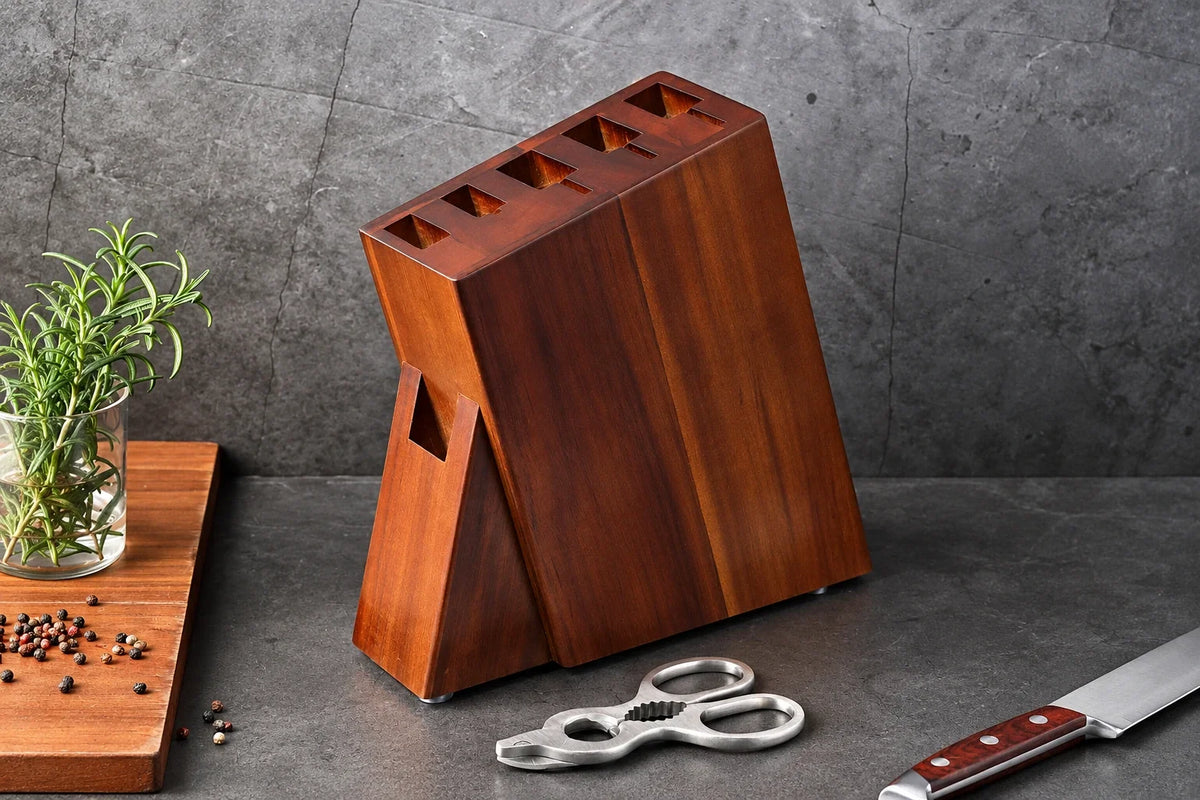
The knife block vs knife stand choice should begin with the knives that need a home and the place you can reserve. A product's overall shape is useful, but it does not establish whether every blade in your collection will fit. Compare the storage format, its dimensions and the actual tools together.
The Acacia Wood Knife Block is listed as a multi-hole format for knives and scissors. Its published size is 24.5 × 16.8 × 7.8 cm, providing a specific starting point for assessing a possible location.
Look at the layout as well as the size
Separate holes give the block a defined arrangement, but the number of knives you own is not a complete fit check. Consider blade width, length and handle shape. A collection of different profiles can require a different arrangement from several similarly sized preparation knives.
Think about which item will be used most often. The useful position is one where the storage layout serves the tools rather than making the whole collection difficult to access. Assess the current product presentation and the supplied information for the particular pieces you intend to place there.
The Acacia block also lists ventilation and silicone feet. Consider that construction alongside the actual storage layout, keeping dimensions and knife fit as the deciding details. Its role is to give the selected tools an organised place between preparation sessions.
Make a short list of the collection beside the measurements of the proposed location. Include the profiles you already own and any specific addition you are considering. Those details make the comparison more useful than selecting by appearance alone.
Compare the upright stand
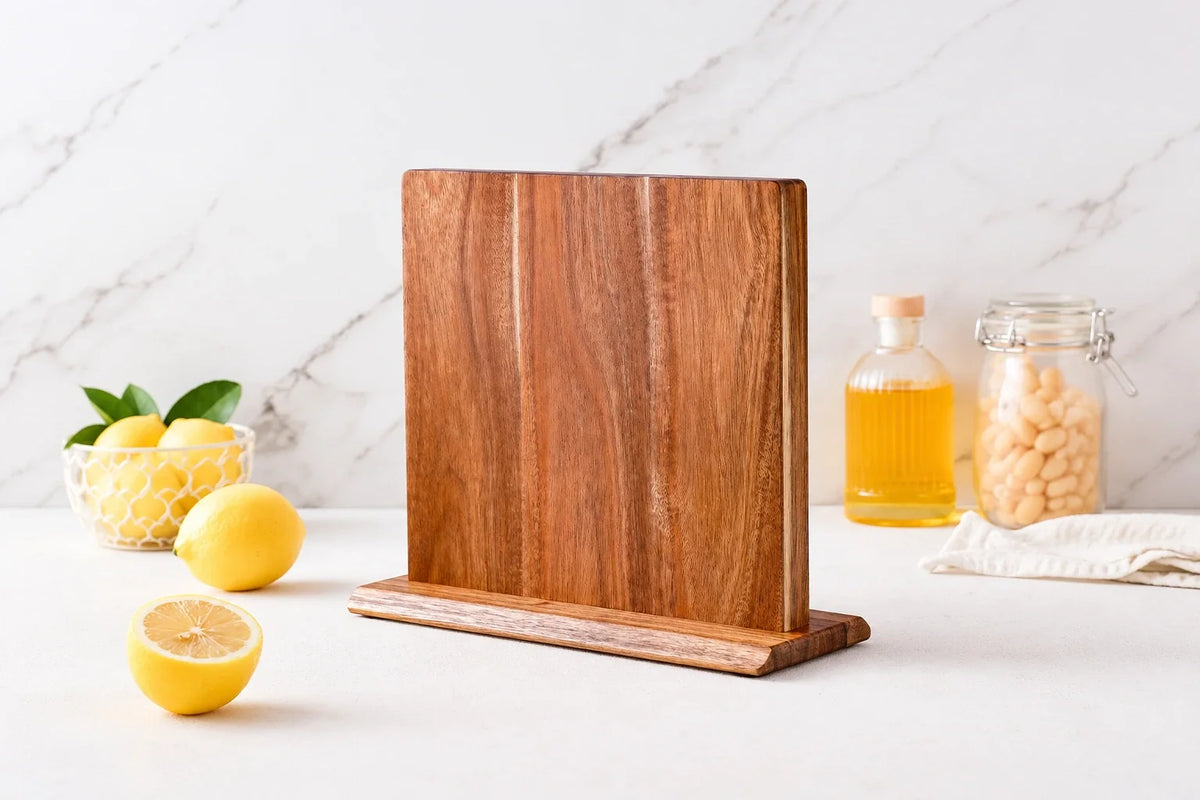
The Wooden Knife Block Stand lists approximately 15.6 cm width, 15.4 cm depth and 22.5 cm height. It is described as upright storage for multiple knives, without a stated knife capacity.
Its width and depth can be compared with a measured worktop position; its height belongs in the clearance check. Leave room for the actual tools and for access, rather than assessing the stand as an empty wooden object.
The public Acacia size is supplied as a three-number measurement without labelled orientation. Confirm the orientation if it determines fit in your chosen position, instead of assigning those numbers to height or footprint by assumption.
Assess the place while the kitchen is active
A position beside the board can look useful until the receiving dishes, ingredients and other meal tools arrive. Think through a normal preparation session and decide which space is genuinely available for permanent storage.
For example, a narrow area may be used for a serving platter at dinner time. Another corner may be within the movement of a cupboard door. The storage choice should reflect those ordinary uses rather than rely on how the worktop looks after everything has been put away.
Our drawer-or-worktop rack guide gives a horizontal alternative to consider. It is useful when neither proposed upright arrangement has a lasting worktop position.
Choose the format around the collection
Shortlist the Acacia block if its layout and confirmed dimensions answer your collection's needs. Shortlist the Wooden Stand if its upright arrangement has a suitable position and the actual tools fit. A different format is worth considering when either check remains unresolved.
Browse KIRU Storage & Setup with the knives and measured location in mind. The most useful comparison combines the product's size with the collection it is intended to organise.

Leave a comment
This site is protected by hCaptcha and the hCaptcha Privacy Policy and Terms of Service apply.