
Care for a stainless steel kitchen knife as a complete product, including its handle and finish. A steel name alone does not answer whether the whole knife can go in a dishwasher or which cleaning treatment it needs. For the Kanso Series, begin with the care information supplied for that exact knife and keep it with your kitchen instructions.
Robert Welch's care guidance also emphasises cleaning, drying and protected storage.
Understand what the construction describes
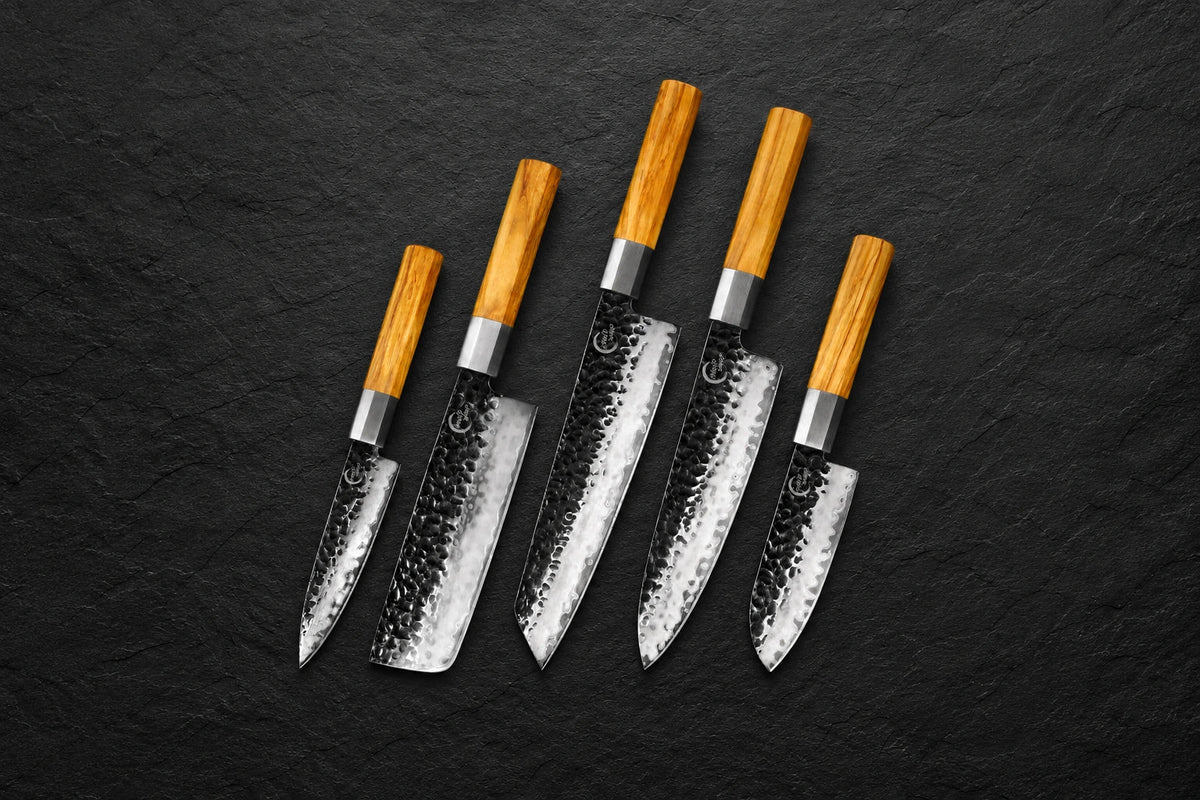
Kanso has an AUS-10 cutting core with two layers of 430 steel, an olive wood handle and a hammered surface with a sandblasted finish. These are different parts of one object. Reading only the outer steel description leaves the handle and surface out of the care decision.
This distinction is useful when comparing knives already in your drawer. One might have an all-metal handle, another a composite handle and another wood. Even if their blade descriptions all include stainless steel, retain the information for each complete knife. Grouping them under a single material label is less helpful than knowing which instructions belong to which item.
Resolve the dishwasher question before cooking
If you hope to use a dishwasher, look for an explicit whole-knife instruction for the product. A description of the steel or handle does not establish that permission. When the supplied information does not resolve the question, ask KIRU about the named knife rather than borrowing a rule from a different range.
For an existing kitchen collection, make a simple record of the care method for each knife. This is especially useful when adults share washing-up duties. A small note kept with appliance and product instructions can prevent the same uncertainty returning after every meal. Keep the record specific enough to distinguish a Kanso knife from a similarly coloured handle in another range.
Let the storage decision support the routine
Think through the last part of care before choosing a block. Where will the knife go once you have completed its cleaning and drying? Does the position leave room for your kettle, chopping board and other regular worktop tasks? Storage should earn its place through the way you use the kitchen.
The Acacia Wood Knife Block offers separate holes for knives and scissors. Its dimensions are 24.5 × 16.8 × 7.8cm, with silicone feet and an approximate weight of 1.78kg. Those measurements help you plan a position; they do not establish that every blade in a mixed collection will fit. Compare the knife profiles you own with the storage arrangement before settling on it.
Keep different ranges recognisable
If you are adding a knife from the Harbor Series, select the required profile and retain its own care information. Harbor includes natural hardwood and composite resin in its handle construction. Similar-looking wooden elements do not make it interchangeable with Kanso's olive wood handle for every care question.
You can organise care information by range, while organising storage by the knife's practical role. For example, keep the everyday preparation knife in its designated place and the bread knife in another suitable position. The kitchen remains understandable without turning steel grades into an invented cleaning system.
Our wooden handle care guide helps connect handle information with the after-prep routine. Explore storage options after measuring the available area. The important decision is a complete route for the complete knife, from finished preparation through care to its next resting place.


Leave a comment
This site is protected by hCaptcha and the hCaptcha Privacy Policy and Terms of Service apply.