
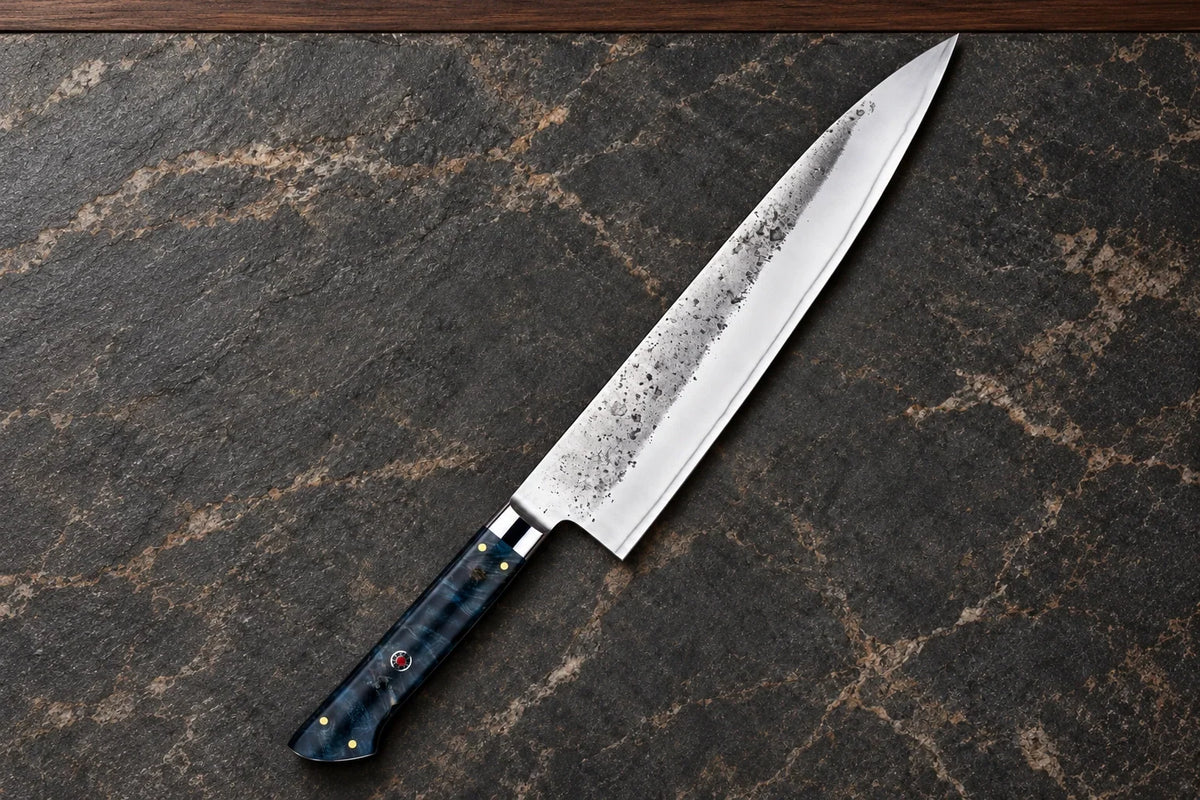
A wooden-handled kitchen knife needs an after-prep routine that considers the complete knife: blade, handle and storage place. Make that route easy to follow rather than treating the handle as a separate decorating project. For the Indigo Series Gyuto Chef Knife, stabilised wood is part of the handle specification; the instructions supplied with the knife remain the starting point for its care.
For everyday care, Robert Welch recommends hand washing, thorough drying and storing blades so their edges are protected.
Give the end of preparation a clear sequence
Imagine finishing a tray of sliced courgettes and peppers. The vegetables have moved into their dish, but the knife is still on the board beside a cloth and a mixing bowl. That is the point to finish with the knife, before starting another task. A designated place for cleaning materials and a known storage destination make the transition easier to remember.
Keep the care instructions near the rest of your kitchen information, particularly when a new knife arrives. Read any guidance for the handle as well as the blade. A wood description tells you what the handle is made from; it does not supply a treatment recipe. If a question about a cleaning product or handle treatment remains unanswered, ask about that specific knife before introducing it.
Make room for the complete knife
A drying area should belong to the knife's routine rather than compete with the evening's washing-up. Think about where a long blade and its handle will sit while you complete the care sequence. If your usual space is crowded with pans, reorganising that area may be more useful than buying another accessory.
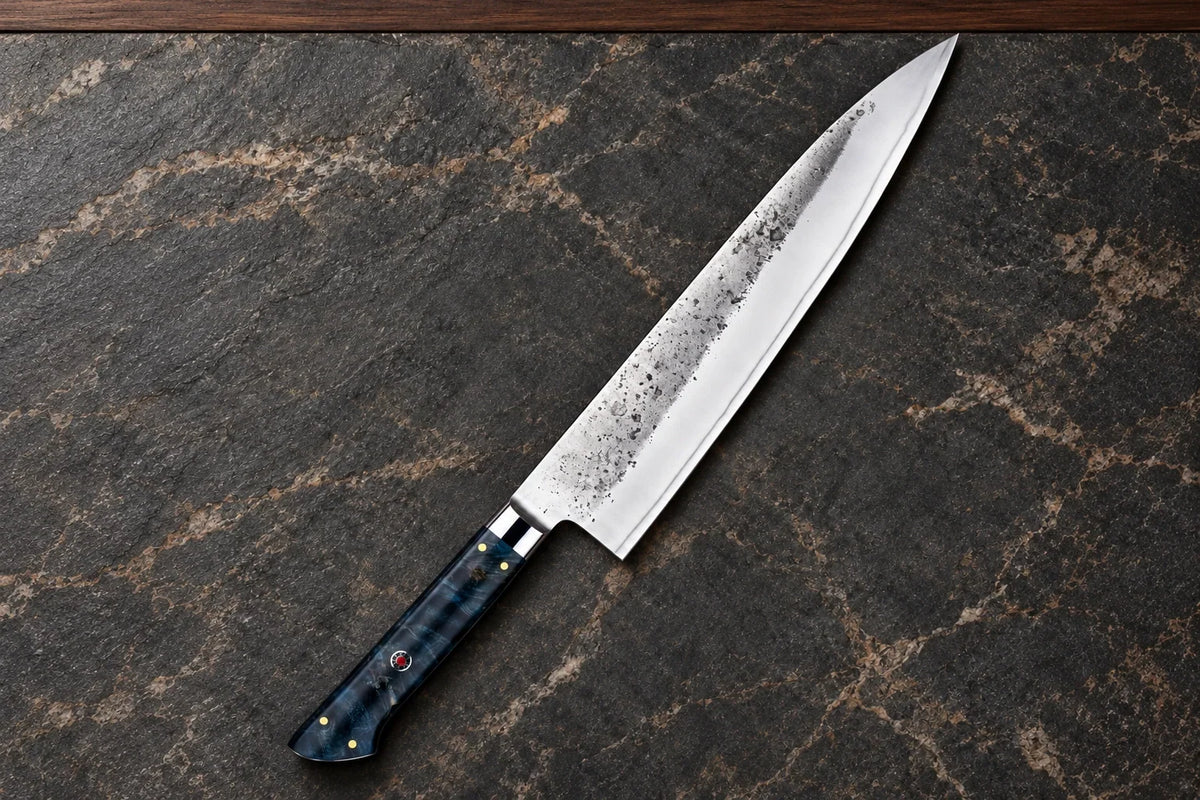
The Indigo Gyuto combines a stabilised wood handle with a three-layer composite blade and a 10Cr15CoMoV core. Those construction details can help identify the knife when requesting care advice. They do not turn every wood-handled knife into the same product. A Indigo Series Kiritsuke Knife may look coordinated on the worktop, but keep its own product information with it.
Plan the return to storage
Decide where the knife belongs before it is needed again. A designated position also makes it easier to see whether the knife is still in use, being cared for or ready for storage. This is particularly useful in a household where different adults prepare different meals.
The Magnetic Knife Block provides double-sided magnetic worktop storage in acacia wood. Its height is 25cm, width 23.5cm and base depth 10cm. Measure the space around it as well as the base: you need a workable route between the preparation area and the chosen position. Check suitability for the knife you intend to store rather than calculating capacity from the block's width alone.
Keep the routine proportionate
A useful routine is one you can finish at the end of ordinary cooking. It should not depend on a shelf of treatments bought because the handle contains wood. Put any product-specific care requirements into the sequence, then choose a storage location that fits the kitchen you actually use.
If you are changing the setup, our guide to cleaning, drying and storing kitchen knives covers the wider transition from preparation to storage. Browse KIRU knife storage with your available space in mind. A clear destination gives the wooden-handled knife a considered place within the kitchen, alongside the blade roles you use every day.


Leave a comment
This site is protected by hCaptcha and the hCaptcha Privacy Policy and Terms of Service apply.